vrijdag 4 november 2011
AAA
Obviously they have all been asleep, the Moodys, the Standard&Poors and the Fitches, when the banks wholesaled their worthless mortgages and doomed debts. The credit rating agencies just continued awarding them top status unblinkingly. With the result that the bubbles grew bigger and bigger, as did the explosions which followed.
But now we are four years from then and now it are mostly state debts which are at stake, I am slightly more inclined to listen to them and to the markets. It might be true that the rating agencies at the moment puncture as much bubbles as they create.
I think so firstly because the rating agencies themselves are shocked by the extent to which they have let themselves be carried away in the financial charade. They seem to have resolved to be more critical in their assessments and to explicitly name and shame obscure and misleading financial constructs.
And secondly because the credit rating agencies, with in their wake the markets, seem to operate in a way which is less speculative and alienated from reality. This I gather from the fact that on the rare occasions that the EU and individual governments show some willingness to really put their financial affairs in order, markets react immediately. At such a moment the interest rate on government bonds goes down and the stock markets go up. Apparently then serious calculations are being made by rating agencies and financial institutions that demonstrate that trust is justified again and that investing can pay again.
The circumstance that what governments announce is generally felt not to be enough for a lasting effect, in my opinion does not alter that conclusion: apparently there are bottoms and ceilings. To that I connect the conclusion that, despite the disproportionate financial fictions, there still is a connection to the real economy. So that there is question of a reality check which aims at serious returns on investments.
The importance of this can be clear when you consider that it could be quite different. It is not inconceivable that markets at some point do no longer respond at all to political initiatives, that there is not any inhibition left whatsoever to interest rise and to speculating the euro to death, and that you no longer need any credit rating. Except for a number of speculators, that’s what we rightly fear the most.


zaterdag 24 september 2011
A Palestinian state
What arguments can you bring in for not wanting a Palestinian state right now?
The idea can be: we must add the West Bank to Israel because that is ancient Jewish territory. This is an ideological position which has for its aim to annex the area. That is simply illegal.
You can say: If Israel can no longer fly over the West Bank, it loses the military control over the airspace and it becomes harder to control the borders. I think that’s true. But I would like to connect this with another thought: if military power is so important, make sure you – unlike minister Lieberman does – maintain contacts with your neighbors in a proper way. Because the loss thereof is probably of more importance when it comes to controlling your military position.
You may think: the Palestinians want to drive in Israel into the sea. Hamas says so explicitly, and that makes negotiating quite impossible in my eyes. Abbas and his club recognizes, at least verbally, the existence of Israel. I think we should cherish that.
The thought may be: besides the rockets from Gaza we will now get them from the West Bank as well. That could very well be the case indeed because Abbas’ authority is not large enough to be able to prevent that from happening. I would not know what you can do against it, so this seems to me to be a real problem.
Thus I arrive at three arguments for and one against. Of course there are many more issues and arguments to bring in, but I think my considerations soon will follow the pattern that just came out: more arguments for the Palestinian state than otherwise.
What I fear is that for the current Israeli government the first argument has the heaviest weight, that’s to say it embraces the ideology of Greater Israel. And that all other arguments must give way to this argument. Over against that position, I like to think that if we let go of the ideology, business can be done about the rest.
Also see Thought Police
vrijdag 9 september 2011
Levinas and Israel
 In a weblog which among other things is interested in Levinas, Judaism and Israel the following question cannot be missed: what was Levinas’ position vis-à-vis Israel?
The first thing to notice when answering this question, is Levinas's commitment to the state of Israel. That attachment was not immediately there – like many others in the Orthodox Jewish environment in which he moved, he initially did not care a lot. But from the fifties onwards to Levinas applied what applied to his compatriot of equal age Raymond Aron: if he was to see that country disappear, he had not had the strength to live on any longer. Not that he has ever thought of migration to Israel, because he was simultaneously too much attached to France for that.
As to the political situation in and around the Jewish state, he generally kept himself away from that. He shrank from publicly commenting on current events.
Based on the rare occasions that he actually did comment, you could reproach him with a certain naivety or Schöngeisterei. Such as in a commentary in which he shows his enthusiasm for the ideas which he believes underly the modern states in which he feels at home, namely France and Israel. Solemnly he writes, after his first visit to Israel: “When a Jew is attached to a large modern Western state, or if he establishes a just state on ancestral land, then he joins again the true tradition of thinking”.
But he also realizes that philosophy cannot do much in the confrontation between politics and ethics, which he thinks is at issue in Israel. Thus he says in an interview with Alain Finkielkraut following the massacre in Sabra and Shatila in 1982: “Conflicts such as between morality and politics are unfortunately not likely to be solved by philosophical reflection”. The thing we should refrain of anyway, he says, is “invoking the Holocaust to say that God is with us in all circumstances. Because that is as odious as was the Gott Mit Uns that was written on the couple belts of the executioners”.
Maybe at this point his naivety gets an assertive trait, because when Finkielkraut in that discussion suggests that the pure reflective soul may well escape the quagmire of history, then he turns Schöngeisterei as it were into a badge of honor by embracing it: “For fear of being called a beautiful soul, one is rather an ugly soul”.
More problematic is that, on one of the few occasions that indeed he philosophically addresses a question on the Israeli-Palestinian conflict, Levinas does with his ideas not add much new or enlightening value. He was asked whether for the Israeli the other is not primarily the Palestinian. “The Other”, he responded, “that’s the fellow-man, not necessarily the close neighbor, but the latter also. And in that sense being-for-the-other is: being for the close neighbor. But if your close neighbor attacks another close neighbor or does an injustice to him, what can you do? At that time the otherness changes of nature; the otherness then can appear as an enemy, or at least the problem poses itself that you need to know who is righteous and who is unrighteous, who is right and who is wrong. Sometimes people are wrong”.
For the length of such a passage Levinas to me becomes instantly irrelevant. Because therein he simply joins in the common discourse of the legal and historical sciences and of the rational considerations of legitimate interests, as they are known to us from social and political philosophy. This is not to say that this discourse is not important - on the contrary - but simply that Levinas does not add anything original to the sophisticated ideas that others have already formed in this field.
Thus I come to a conclusion that I reached already before. In the political field – that is the macro level of human interaction – the use of Levinas is very limited. However, at the meso and micro level, at which for instance the human interaction in organizations takes place, he may be useful all the more.
See also How naïve is Levinas really?
vrijdag 26 augustus 2011
The village of Norway
After the attacks in Norway I read a few comments about the village-like character of Norway. There there still is a sense of community, people trust each other and they keep Europe and cosmopolitanism out. It sounds almost like Geert Wilders’s dream, if only those damned socialists would not cherish their Muslims so dearly. In this village, ritual slaughter is allowed to Muslims and not to Jews, and Geert would rather have that exactly the other way round.
Indeed, something village-like cannot be denied to Norway. Attacks were unknown from personal experience. Perhaps therefore Breivik’s crime hit the people extra hard, though the kind of suffering which is caused this way is universally terrible, wherever it occurs.
Something remarkable, I would say village-like, there was also to the first reactions of the conference participants on the shots of the terrorist, namely immediate associations with the Israeli-Palestinian conflict. To clarify this reaction, it is important to know that the day before on the island Utoya the people had been extensively involved in promoting the Palestinian cause.
Among the issues discussed some were, to my opinion, important and worthy of consideration, such as calls for ending the occupation of the West Bank and support to the formation of a Palestinian state.
But there were also problematic issues. The Foreign Minister Gahr Stoere, for instance, who attended the conference, would without problems approve of a plea for a boycott of Israel – see photo –, which is something else than a boycott of the settlements. And he brought to the conference the demonizing set of ideas which after the attack was expressed once again by Norway's ambassador to Israel: that Hamas’s terrorism against Israel is more justified than other terrorism. In short, they were bashing Israel a few days long already.
In this situation of village-like convenient arrangement of good guys versus bad guys, the following can happen. According to a report by Adrian Pracon, a survivor of the massacre, when the shooting began some people immediately thought of Gaza. This was going to be a simulation of what they had learned just now, so of what according to the conference Israel uses to do in Gaza.
“Some of my friends tried to stop him by talking to him. Many people thought that it was a test ... comparing it to how it is to live in Gaza. So many people went to him and tried to talk to him, but they were shot immediately”, tells Adrian Pracon.
Except that the idea that it might be serious was (happily) far away, the only connection the conference participants were able to establish between the shooting and the rest of the world was the thought of the Israeli-Palestinian conflict. Apparently to these people words like ‘violence’, ‘shooting’, ‘quarrel’ are largely synonymous with that conflict. It has become proverbial for everything which has to do with shooting, you can think of nothing else anymore.
When people start to think as schematically as this, what happened in their heads? Because something must have happened, unmistakeably. People have done something to images in their heads, or they have let others do something to them.
Somehow distortion of information takes place. Indeed, in substance, there is no justification for such stereotyping and for attributing such negative symbolic value only to Israel. Not because there are no terrible things to report. But because that is not unique to Israel and not highly distinctive either.
It is true, I agree with everyone who thinks that the creeping colonization of the West Bank is a dirty trick, and that every victim that falls in the fight against missiles from Gaza is one too many. But it must also be said that about this situation in Israel there is a lot of discussion. There are historians who with unprecedented openness figure out what exactly happened and happens and who do not spare Israel. And this summer 60,000 Palestinians are on vacation in Israel.
In addition, there are quite a few regimes and militias in the world that make as many or more victims and in more horrible ways. And such for many years already, and among its own people. Or would the idea be that in those cases it is just the leaders who are bad? They are depraved – the common people in all these countries are, as noble savages, only victims. And would it be thought perhaps that in Israel the whole community is bad?
Yes, something like that must be the case. A suchlike distortion must take place in people’s minds, otherwise I cannot explain the exclusive demonization of Israel. Because objectively spoken, there is no reason why the demoncard should be played exclusively to Israel. So if nevertheless you do so, then you do something yourself - in your head. It happens more often than can be justified, I'm afraid.
Or than well-minded people want to account for, I hope – even in a village. I am justified in hoping so because, after all, the village of Norway has been the scene of the first treaty between Israel and the Palestinians.
See also Thought Police
dinsdag 2 augustus 2011
Thought Police

 Moral decisions can be extremely difficult.
Some people point their finger at members of the Jewish Councils of the Second World War or to others who by a wicked enemy were forced into the impossible choice between saving what could be saved or total resistance.
I really would not have known. The most important thing in these matters is, I believe, that we do not too quickly condemn and judge.
There are also questions which are made to look very difficult but which, morally spoken, are cristal clear . For me, the Israeli occupation of the West Bank is such an issue. There is nothing difficult about it, that area belongs to the Palestinians and Israël has no business there. In my eyes therefore there is nothing wrong with a boycott of settlement products - easily distinguished from a boycott of Israel or Israeli products in general.
I am sufficiently historian to understand that these areas are attractive for Jews to settle there. After all in Biblical times Judea and Samaria were key parts of the Jewish territory. There are also safety considerations that hint towards occupation, because Israel’s military position is more firm with the West Bank included. And finally ordinary power and land hunger play their parts.
But these considerations don’t make the issue morally more difficult. Given Israël’s foundation in the UN decision of 1947, in the West Bank Israël momentarily literally exceeds its limits, it does not belong there. Moreover, this transgression of borders causes a lot of damage for Israël at the political-diplomatic level. Its safety position suffers more thereby than can be compensated by physical-military positions.
This situation is bad enough, but I think worst of all may be that since the adoption of the anti-boycott law by the Israeli parliament two weeks ago an open discussion on these issues is prohibited. Anyone who objects to the occupation and for that reason calls for a boycott of settlement products is now in violation of the law.
Here no longer only the Jewish country is at stake, but the entire Jewish tradition. This touches the heart of that tradition. Because if there is anything that characterized Judaism for centuries, it were the culture of debate and the many angles of (moral) positions. One may be in favour or against a boycott, but a free discussion on the subject should be guaranteed. Therefore I can completely identify with the condemnation of the law by the Israeli Council of Liberal Rabbis: “This is an unprecedented dangerous step onto a slippery slope that continuously erodes the Jewish character and democratic nature of Israel”.
Thought police does not suit Israël.
maandag 1 augustus 2011
Polyphony
 Not seldom the Jewish tradition is praised by people (including myself) for the multitude of opinions that can exist therein. The Talmud takes seriously different interpretations of transmitted texts and encourages discussion about them. Dogmatic coercion is not an issue, and that can be viewed as a pleasant and mature way of dealing with tradition and texts.
But there’s another current within the Jewish tradition which is equally old and respected. This current stresses harmony and a kind of mystical unity of the Jewish people. So, with the two currents taken together, how much polyphony is actually possible within the Jewish tradition as a whole? Let us have a closer look at that question.
Then at a first glance it appears that there is little question of polyphony. Because for example the book of Exodus describes how Moses went up the mountain and was there all alone with God when he received the Torah. The Midrash elaborates on that when it underlines the unequivocality of the revelation by the statement that where there is only the slightest division, the presence of God does not want to dwell. Philo of Alexandria connects to that when he says that all who rebel will be consumed by their inner desires, and Jehuda Halevi emphasizes the existence of a Jewish folk-soul that unites all Jews.
But it also says in Exodus that all the people have been listening to what happened at Sinai. Or rather, have been watching the voices. Furthermore, God proclaimed to Moses on Mount Sinai not only the Torah which afterwards was written down by Moses, but he also gave oral explanations, including any explanations that there ever would be, however contemporary they might be. Because, says the Talmud, even whatever any clever and serious student in the future will ask his teacher, has been revealed to Moses at Sinai. This means that the Torah cannot be but an explosive mixture, which includes many different things, or even contradictory things.
I emphatically confess myself to the current that cherishes the multiplicity of forms and voices. Because I associate the recognition of the multiplicity with a form of maturity. In that sense, I think the Jewish tradition is mature. There is that desire for an idyllic, smooth unity, but the tolerance for dissent is also well developed. This is evident from the multitude of discussing voices in the Talmud.
In our days this appears in yet another way. Namely in the way the Jewish image of the state of Israel is becoming more mature.
For a long time there was only one and therefore dominant image of Israel and its creation among Israeli historians. That was the picture of the small, brave Israel that stood alone against all-powerful Arab enemies. Like David against Goliath. In which picture the state was seen as the messianic, triumphant outcome of two thousand years diaspora and persecution. And in which the failure of peace plans was entirely due to the Arabs.
This was a way for historians to contribute to the unity and morale of the new state. It was their contribution to the myth-creation, a sort of feel-good history that the people needed to achieve the necessary efforts.
But, as happens with idyllic images and myths, they sooner or later get shattered. In the eighties there was a new group of Israeli historians (who are therefore called the New Historians) who opposed that idyllic image of Israel. They call that image one-sided and propagandistic. They are committed to view matters not only from the Israeli perspective. In their view, there is not just one single player (Israël) with the others as puppets. The Palestinians and Arabs are full players.
The self-criticism that is practiced by these historians caused a great deal of fuss: they were accused of befouling their own nest and even left-wing politicians were talking about a suicidal strategy. My point is that these historians have been able to break through the oppressiveness and coercion that is always connected with a closed dominant historical image. Now there is something to choose. There are now several documented and legitimate ways to look at the same thing, there are multiple voices, even if the discussions take place mainly in academic circles.
I myself am inclined to consider the emergence of these countervoices as evidence of the strength of Israeli society. I think it testifies of maturity if a society is able to produce and take seriously this kind of internal critical voices. Comparable to the way Torah always inspired people to take responsibility and to break the atmosphere of mystical unity that can surround the Torah as well. The New Historians are an expression of critical Jewish consciousness and therefore an asset to be proud of.
See also History as an exact science
zaterdag 16 juli 2011
Just in time
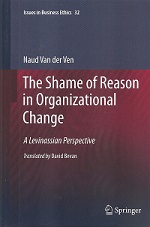
 Last week The Shame of Reason appeared, the English translation by David Bevan of my book Schaamte en verandering. Right before the holidays, just in time for all those Englishmen, Americans and Australians who on their beaches en masse start reading the book.
Nonsense of course, but perhaps the ‘just-in-time’ may hold with regard to a quite different trend that occupies the media: the impending demise of the traditional booktrade. Within a few years from now, such a book as mine might not find an editor anymore, at least for a paper edition.
Everywhere I hear sad news from the side of publishers and bookshops. In Holland sales of general books shrank in the last five months by 3.8 percent and 4.7 percent in 2010. Publishers delete jobs and titles and join with one another in order to survive. Bookstores are struggling and cut staff. The book-selling markets which are currently best performing are those at the petrol station and supermarket. As causes for this development are mentioned the digitization, the economic crisis and the trend that people read less and less.
Do I myself get sad because of this trend?
Well, if the trend would stand for the demise of interesting ideas that are being well expressed, I certainly would, because I can not easily do without. And indeed, the traditional publishers and bookstores are precisely the places where one can find that. There one may even physically enjoy the nice combination of style and thinking, with or without a cup of coffee. But the question is whether those physical places are really essential and whether good writing in electronic form cannot as well meet my needs.
My gloom is even further relativized because I, frankly, never was a fan of strict literary bookshops, of the psychological novel "as a pillar of our literacy" (Maartje Somers) and of the cliques that go with them. As for me, I am rather sympathetic to those who, as Theodore de Boer recently described with respect to the Dutch poets of the fifties, radically break away from an age-old tradition of adoration of letters. Which break in the vision of De Boer is also a departure from Platonic metaphysics and classical aesthetics.
What remains is that I am pleased with the print publication of my book. Actually I have the best of both worlds, because the full electronic version is already available at the same time.
Abonneren op:
Posts (Atom)