Posts tonen met het label Greek philosophy. Alle posts tonen

dinsdag 22 maart 2016

How Jewish is Maimonides?


Recently, I followed an interesting course on Maimonides, in which his life, acts and  work were discussed. While being confronted with all of that, you can not fail being impressed again by this giant.

Nevertheless I am left with a serious question, especially in reaction to the book The Guide for the Perplexed by Maimonides. The teacher of the course told that the rabbi/philosopher wrote that book for the enlightened Jewish minds of his time who had come into contact with Aristotle’s rationalism. Maimonides wanted to show that the same Greek wisdom was to be found also in Judaism and that therefore the Jewish intellectual elite did not have to go looking elsewhere, where according to him they would easily get lost.

However, that Jewish equivalent of Greek wisdom should be available only for the initiated, and had to remain secret for ordinary people because they were too stupid to understand the doctrine. The initiate elite could then make sure the uninitiated people receive the pieces secret doctrine at the time they were, in the opinion of the elite, ready for it.

This fact of a secret doctrine for initiates with a corresponding social hierarchy strikes  me as contrarious to the direction of the rabbis from the beginning of the era. In rabbinical writings, I believe to hear arguments for study of Torah as something that preferably as many as possible should be able to participate in throughout their lives. “Go and learn”, Hillel said, and in saying so he did not address specifically the smarter people. And what they had to learn was nothing secret, on the contrary, it belonged to Revelation.

That is not to say that in the Jewish tradition exclusion did not occur. There were at various times in various places aristocracies of rabbinical dynasties who divided leading positions among themselves and didn’t let in outsiders. But – and this is my point – that practice was not supported by an ideology that wants to keep a priori certain knowledge limited to a group of initiates.

Therefore, in my view it’s very logical and understandable that internal Jewish opposition came against Maimonides. Which led to the so-called ‘Maimonidean controversies’ that regularly flared up from the 12th to the 16th century. Among others, the philosopher Chasdai Crescas manifested himself as opponent of Maimonides.

For him and other opponents in the controversies something big was at stake, namely the following. Through his avid embrace of universalizing reason Maimonides takes leave, according to them, of the kind of rationality which is employed by Tanakh and Talmud. The latter is a rationality that allows for plurality of different logics, for inconsistencies and for the tragedy of conflicting logics that nonetheless are legitimate.

That appeals to me. A danger may be that with that thought you end up in romantic or mystical atmospheres. The opposition of Crescas against Maimonides has been interpreted along those lines, but that’s not what I aim at. What I am looking for is, right on the level of rationality, an approach that precisely in its way of dealing with reason – or reasons – may be called more Jewish than that of Maimonides.

I think that can be found in Levinas is because he, without being romantic, for all thinking “presupposes a specific political community”. These last words are from the philosopher Dennis Baert, and if you say “I do not understand”, then I agree. But those words in any case point to something different from what is universally valid. It’s primarily my intuition which says that this has something to do with the previous. But I’ll have to study on that further.

Also see Wittgenstein as Talmudist

zondag 9 augustus 2015

Self-reflection by the other


If you had to nominate a profound value that has been produced and cherished by Western civilization, would that not be the capacity for self-reflection?

This proposition is sometimes suggested during the workshop Thinking for someone else, and I think it is true. The Greek motto ‘Know thyself’, combined with the relentless search for truth by Socrates, has triggered a millennia long tradition of critical research. This has not only produced science and critical philosophy, but as its most praiseworthy result – in this view – also a tradition of self-scrutiny.

For examples of the latter, one can think of the Confessions of St. Augustine, the Essays of Montaigne or the Confessions of Rousseau. Typical of this tradition of self-scrutiny is that the self appears twice. The self is doing the action of the investigation, and thus appears as actor. But the self is also the object of the research performed by itself. Quite an achievement indeed.

Undeniably this capacity for self-reflection is something to be proud of. But is it the best thing a man or a culture can achieve? Will you, as a culture, manage in the end, working with the ability to self-reflect as your highest value? The proposition does not pretend that, but I add the question because I think it is an important question to which the answer is no. And because our culture is troubled by that negative answer.

That trouble, in my opinion, consists in the circumstance that, through the emphasis on the self in a double sense, the horizon of thought will also coincide with the horizon of self. The universe of the self-critical self is that of the self. Self-reflection remains reflection of the self on the self. Autonomy is the norm, the self remains its own initiator and author. Many beautiful things can spring therefrom, but the repetition of all those words ‘self’ also emphasizes the solipsistic character of autonomy thinking. How restrictive that is, is shown if you put another – self-invented – word next to it: other-reflection.

By which I mean: reflection – on yourself – that is not triggered by yourself but by someone else. Because, whatever you come up with in your attempts at self-criticism or whatever discipline you display in that, the world turns out to be just thát bit greater than you could imagine, and the other precisely different from what you could imagine. There are other universes indeed, which I can not get at by myself. There self-reflection – triggered by the self – stops, and other-reflection – triggered by something surprising from the other – starts.

This is difficult for Socrates and his followers. They indeed keep asking questions, but they mostly invent them themselves.

Also see Immune and Levinas and Rousseau

zondag 19 juli 2015

Is the world sound?


In newspaper interviews with several refugees recently the Iranian Pouya Zarchin was cited. He fled in 2011 from Iran to the Netherlands with a fake Spanish passport and tells how scared he was. “If I would get caught and returned to Iran, prison sentence would await me. Or worse. Dutch people can not understand that fear.”

Another, but related story was Wanda Reisel’s, referring to the persecution her family suffered during the Second World War. Because of the impact of that familyhistory she sees herself leading a double life. “My fantasy life is as important as, perhaps even more important than real life. In my head, everything is in order and secure, but the outside world is threatening and unreliable: before you know it you’ll be betrayed, arrested and put on transport. Because you show who you are”.

What resounds in both quotations is a conception of the world as something threatening, chaotic, unreliable. At best, its frightening character is to overcome by building a strong inner life over against it. Anyway, the mood of the quotes does not know of an objectively existing, sound ordering of the world, in which we would participate.

Then, indeed, the feeling about life recently expressed by the philosopher Ger Groot is entirely different. For him, there is order, deep down everything is all right. “Despite appearances to the contrary, right in our hearts we are convinced that the world is in order, that our existence is harmonious, that happiness is the raw material of reality.”

Groot is not unique in this way of experiencing the world. On the contrary, therewith he is an exponent of what rightly could be called the ‘Western order-thinking’. At its largest that order thinking is expressed in the Christian worldview. Its clue is the idea that, no matter how perverted our earth may get, the world has in fact already been redeemed and the results of such redemption are at our disposal in the form of sacraments and other objectified salvation.

In fact, the latter is wasted on Ger Groot, because he is an atheist. But the underlying mood, indeed, is his: fundamentally, there is order in the world, the world is just right. And for holding that view one does not necessarily have to be Christian, as is evident from the world view of even the most skeptical stream of Greek thought, the Stoa. The Stoa’s philosophy is based on the idea that everything in nature happens in a necessary manner. There is nothing to stop it, but with the help of reason you can give everything a place and defuse negative emotions. By joining the prevailing order, you will still be happy.

If it is true that both movements, Christianity and the Stoa, go back to Greek thought, it indicates how much the idea of a sound world is a Greek idea. One of the most powerful recent expressions of this order thinking – with once again an appeal on Greece – comes from Heidegger. He bases on it, with all his pessimism about the technocratic direction of Western civilization, a deep faith and an intense joy. But he always kept it half hidden, which was reason for Cornelis Verhoeven to refer once to Heidegger as ‘that cheat’.

How different from that sounds for example the Israeli writer David Grossman, in a recent interview with Ikon-House. “We Jews are looking for a different way of being in this world. Without being defined by fear and by wars, without enemy. To rely upon our Being. One of the simplest definitions of ‘Jew’ through the centuries is: someone who, collectively or individually, never felt at home in the world.”

You could explain the latter mood because Jews for centuries have been living in the diaspora, in constant dependence on the whims of others. So from a kind of accumulated post-traumatic stress disorder.

But it could also be that doubt about a just world order was much earlier articulated in Jewish culture. That would, already centuries before the beginning of the era, have found its way into biblical writings, like the Book of Job.

Whatever explanation you choose, both developments may help us to understand a little better why in the course of history Jews for Christians and other ‘Greek’ thinkers posed a threat: they questioned the Greek and Christian base feeling of a ‘sound world’. From that confrontation you can get very chagrined.

Also see Plato disproved and Order

zaterdag 4 juli 2015

Greece and Democracy


It might well be: that Greece simply does not fit into the European Union.

Of course it belongs there because it is a European country and even the cradle of European civilization. And because we like the Greeks to share in our prosperity.

But it is a serious question whether all that is reason enough for membership of the EU. It could well be that minimal levels of polity, taxation and anti-corruption appear to be non-negotiable minimum requirements which must be met in any case. And Greece fails that test.

The reason that Ireland, Spain and Portugal have been more successful in finding their way out of the economic crisis probably lies in that they better meet those minimum requirements. Because these elements were present in their culture and mentality already for some time.

As long as these – indeed technocratic – conditions are not met, a democratic system can not function properly. At least, it can destroy more than you want. The democratic election of Tsipras and then the actions of his government might very well turn out to be a catastrophe.

In that case the functioning of the current Greek democracy (“one hundred thousand civil servants  extra!”) will confirm the dislike that almost all ancient Greek thinkers, including Plato and Aristotle, had for the democratic form of government. Which they accused of being too fickle, too prone to follow the issues of the day – with the risk that emotions prevail over well-thought out decision-making and that too little attention is given to the long term.

The great ancient Greek thinkers were not aware of the above conditions. They did not know that, when they are met, democracy is quite possible and viable. I am afraid that today’s Greeks still do not know.

Also see Where do universal values bring us?

woensdag 18 februari 2015

Professional philosophy's sad course


What do the philosophers Levinas and Nussbaum have in common except that they are Jewish?

What strikes me – and I don’t know to what extent that’s Jewish – is that they both started off with  similar good philosophical intentions. Ánd: that in both cases the trade somewhat has been spoiled.

Levinas’s good intention consisted in his wish to, while reasoning, escape the tyranny of reason. That was bound to fail, you might say, but nevertheless he díd it, a large part of his philosophical life. He showed, up to the very way he formulated and argued, how Western philosophy, at least from Plato onwards, can be called an exercise of equalization of diversity through the uniformity of reason. He called that equalization the ‘domination of the Same’, and opposed to that the Other.

Nussbaum formulated her good intention as: getting away from the Platonic abstractions to which our society and science in her eyes are still too much attached. By that she was referring to an unhealthy privileging of mind over body, of policymaking over implementation and of abstract ideals over concrete goals. To get rid of that, she sought to draw upon he thinking of Aristotle, because he would do more justice to the concreteness of human existence than Plato did.

But then the philosophical lifes of Levinas (1906-1995) and Nussbaum (1947) are quite different, as much as the areas and subjects they dwell upon diverge widely. Levinas worked until about sixty at a Jewish school, first as a teacher, then as director. Besides he published a lot in the fields of philosophy and judaïsm. 

Nussbaum, after graduating, taught at Harvard, Brown University and Chicago. In addition she – often in collaboration with development economist Amartya Sen – does research in the field of economic development, ethics and pedagogy, and publishes extensively on these subjects.

ut amidst all these differences I discover a parallel, and one that to me is pretty shocking. Namely that, as the philosophical careers of Levinas and Nussbaum develop, they seem to get further away from their original intentions as mentioned above.

In itself that needs not to be a wrong development. Indeed, advancing insights are always welcome. But it does not look like advancing insights. Because in that case the changes of direction should have taken place in an argued way, in the sense that Levinas and Nussbaum convinced us that Plato might have been more right than they first thought.

But that’s not what they do. It seems, rather, that they fall prey to the cunning suction to which philosophy is easily exposed and through which especially professional philosophers – by the absence of confrontation with compelling practical issues? – slip into the trap of universalizing reason.

So, I make the connection with Levinas’s and Nussbaum’s professional philosophical positions. In the case of Levinas, because I see the disappointing about-face displayed when, after a long life as a philosophical outsider, he in the sixties reached the academic position he so coveted. From this position he published the book Otherwise than Being, which – unlike the work of his early and middle period – abandons the anarchist, undecided openness between the Same and the Other in favor of a fundamental, foundational position for the Other. I tend to see in this philosophical hierarchy the reflection of the academic, in a sense Platonic, hierarchy into which Levinas then had entered.

Nussbaum from the outset sincerely sought the connection between her thinking and pedagogical and developmental work. But in the eyes of many commentators those efforts soon after her breakthrough with the book The Fragility of Goodness got stuck in excessively theoretical and abstract arguments. In the formulation of medical doctor/philosopher Bert Keizer: “The problem with people like Nussbaum is that they only deal with people like Nussbaum”.

So, the decline into an intellectual Platonic schema in her career occurred much earlier than in Levinas’s career. However, a parallel can be found in the idea that a position at the academy may have played a role: Nussbaum has from the outset been a professional philosopher.

Should we, therefore, better not mourn when independent philosophy faculties are threatened with closure, as in Rotterdam and Amsterdam?

Maybe not, as long as there continues to be philosophizing.

Also see Levinas and Spinoza

zaterdag 29 maart 2014

Immune


To remain equanimous and unperturbable, preferably under all circumstances. Thus was, traditionally, described what philosophy was about and so it still is by some.

Last week I was reminded to that view in an interview with the French philosopher and sociologist Frédéric Lenoir. He told about his admiration for the stoic Dutch Holocaust-victim Etty Hillesum because she had reached the situation that philosophers always considered to be supreme, namely the one in which nothing can hurt you deeply anymore. “Philosophers have always said, since the early Greeks: happiness does not depend on the situation you are in”. It is easy indeed to recognize in this statement Socrates’ goal of equanimity which he preached up to his poisoned cup, and which is the goal of many other philosophers to our time.

I can very well understand that man, in the midst of so many earthly turmoil and instability, looks for a kind of invulnerability. Still, I'm glad there are philosophers who questioned that desire for absolute certainty or exposed it as a pursuit of power. Nietzsche started doing so, and the twentieth-century postmodern philosophers followed in his footsteps. But these trends are far from being taken seriously on a broad scale. May that be called true philosophy, it is asked then. Because, true philosophy strives for absolute certainty, doesn’t it?

The problem is that the latter aim produces, besides certainty and safety, also a lot of nasty things, mostly of an uncanny character. I think of the deep-rooted tendency in our society  to objectification and measurement which can give our work floors and manners the sterility that many periodically suffer from. I think also of the extent to which people live alongside each other, safe but untouchable, and more chilly than they might want.
This way of communicating, which has learned not to touch core issues any longer, could very well stem from that age-old philosophical program that tries to reduce our touchability. With its help we have managed to develop to a high level the art of communicative immunity. The result is a safe and efficient society, but one that sometimes is nothing about any longer.

But how, then, is that communicative poverty to be related to Etty Hillesum, with whom I started this piece? Isn’t she an icon of openness and engagement with what was going on around her? Yes, maybe. If it is not the case – as some said of her – that she idolized her teenagegirl-like commitment; so if her engagement was sincere, then that matches obviously very well with the widely sought immunity.

You could say that the Etty Hillesum’s sacrificial heroism (as also eg Mother Theresa’s), and the communicative sterility of our behavior are two sides of the same coin. Both are strategies for achieving immunity, and the one succeeds through total surrender and the other by screening off touchability.

What falls out is the daily mix of vulnerabilities, in which injuries and excuses, dullness and success alternate. The trivial touchability gets orphaned . That is to say, to simply exchange about things that matter becomes problematic. It is true, there is no heroism involved in such exchange, but by rich and warm communication it's that which may hold off sterility.

Too few philosophers know about this. I cherish those who make it a subject of their speculations, and I continue to call them philosopher despite everything.

Also see Taylor, Levinas and Emptiness, The Trap of Universalizing Reason and Progress after all


donderdag 31 oktober 2013

Landmarks


All religion is all alike, so you can regularly hear and read. Traditions that once were clearly defined today are more intertwined. More and more people assemble their own philosophy of life from a range of different traditions. The reason for that, says for example the magazine Happinez, is that people are looking for guidance and ‘something’ existential that transcends us. And some of that may be found in any tradition.

But sometimes one can – I think – surely draw clear marking lines between religions. A sharp line, namely between Judaism and Christianity, I came across lately concerning the question of where to look for deeper truths.

I read about the great Christian mystic Meister Eckhart. From him comes the statement “Why do you seek it outside of you? Why don’t you stay in your innermost and grab what is good in yourself? After all, you carry the whole truth substantially within you”.

This may sound familiar to us, not only from a knowledge of ancient or medieval mystics, but also from more contemporary self-centered spiritual training programs like Avatar or Landmark. The idea that the entire cosmos is rooted in yourself, is apparently deeply anchored in the Western genes.

This is different in the Jewish tradition. Judaism also knows the belief that each person is a cosmos in itself, according to the Talmudic statement that who rescues a person rescues a  world. But the fascination here is connected rather to the radical differences between the cosmoses, than to the radical otherness of another person.

A corollary of this fascination is the belief that one therefore does not carry the whole world  substantially within oneself. On the contrary: somethings keep slipping from me, namely that in which another person is substantially other indeed. In a way that I never could imagine beforehand.

With this approach the Jewish tradition creates its own puzzles and questions: how can we understand each other, how can we, with those radical differences, live together ?

It is clear, anyway, that the self is never self-sufficient.

Also see Holy Fire and Secular Varieties

vrijdag 8 februari 2013

(Un)purity

Vaguely I was aware of it, but I never realized it as precisely as described by Stuart Isacoff in The Octave. That the establishment of our tonal system – in which we modulate through all keys back and forward and in doing so produce the most beautiful musical constructions – is the result of a major battle, and that this battle proceeded along theological and philosophical lines. The story of that struggle can be read as a sound built version of a larger story. If you want: a liberation story that has interfaces with the emancipation of Western man from the tutelage of the Greek classics and the Christian church.

The story begins with ideas and with a problem. The ideas include the view – based on Pythagoras and Plato – that music is the reflection of a universe which is organized according to harmonious mathematical relationships. Music therefore must be composed of pure intervals such as the perfect fifth (3:2) and the perfect fourth (4:3).

The problem with this was that Pythagoras’s formulas left no space for some very popular harmonies: the major thirds, the minor thirds and their counterparts, the sixths. These intervals were so popular because they made music more intimate, more sensual and more expressive. But their use generated a lot of discussion, because according to opponents these intervals did not fit into the the world order as proclaimed by Pythagoras and the Church.

There were quite some solutions for this problem. They were found in the musical practice and consisted in more or less cheating as to the purity of the intervals. With stringed instruments this could be done because the musician has to pitch the tone himself and always can intonate slightly higher or lower. Singers could do so the same by constantly adapting their pitch to make the different intervals sound together as harmoniously as possible.

These were pragmatic solutions in which the problem was not calked and which did not challenge the guardians of the strict mathematical order. But these solutions were half-baked, because singers were accompanied by organs and there was music written for strings with harpsichord accompaniment. And with keyboard instruments such as organ and harpsichord one can not intonate while playing as it can be done with a voice or a string. Instruments must be tuned properly in advance, and when you want to play thirds on them then you have to consciously tune them differently than when only fifths and quarters are to be heard.

This technical feature left less room for pragmatism, the question of tuning had quite some theoretical aspects. That’s why it soon attracted the attention and the interference of more or less self-appointed guardians of the divinely established order. And these had fundamental objections against any infringement of the pure mathematical relationships.

Meanwhile blood was thicker than water and musicians tried all kinds of tunings on their  keyboards. Concessions were made as to the purity of the intervals for the sake of the possibility to unlimitedly interconnect a variety of fifths, fourths, thirds and octaves without the music getting terribly false.

The opponents were not amused. The 16th century music theorist Zarlino Gioseffo believed, like many others, that singers naturally sing pure intervals and that the new tunings threatened the world’s unity. He was offended when Vincenzo Galilei (father of Galileo Galilei) found that singers in practice go in one piece through different tunings because they are constantly looking for a beautiful harmony. Galilei reproached Zarlino that he fought for an illusion and that the music had to be completely freed from the tyranny of the inviolable numbers.

Rousseau also took position in the debate and he chose for his own variant of the cosmic order. Therein music figured as a primeval force that definitely had to be defended against the refined and therefore decadent experimental tunings. Even Newton, who in his physical work was brave enough to describe the world as it is rather than as it should be according to tradition, showed conservative here: “It is unworthy of philosophers to interfere with the pure proportions” he thought.

In particular, in the appeal which is made here to the sanctity of a divine natural order – against the praxis actually experienced or sought by people – a parallel can be drawn between what happened in the musical area and what in other areas is still happening. I am thinking of some representatives of the established order that label gay sexuality as unnatural and therefore as undesirable. Or of managers who barely pay attention to the actual undercurrents in their organization because their self-invented order leaves no room for them.

From this perspective one could call the musical struggle against the illusion of purity and pro  the multiplicity of lived practice an exemplary European project. And fortunately that struggle  ended well. In the late 17th  century the physicist Daniel Bernoulli was able to show that each tone produces overtones and that the series of overtones ‘above’ the basic tone of a string is much larger than originally thought. Isacoff: “These additional sounds are an endless expansion of the range with tones that are generally not harmonious. So all vibrating bodies float in a sea of dissonants. The idea that nature has a preference for pure harmonies was, it appeared, permanently expelled from the scene.”

Also see Order

vrijdag 8 juni 2012

Parrhesia


If parrhesia is a virtue than the Jewish people may be called virtuous indeed. Because parrhesia can be translated as ‘frankness’, or ‘outspokenness’ or as ‘saying what you think’. Well, that uses to come easy to a lot of Jews.

Yet the word does not stem from the Jewish tradition but from the Greek. The word parrhesia first appears in Euripides and continues to appear from the end of the fifth century before the common era in the writings of classical Greek antiquity.

In our time the word was revitalized by the French philosopher Michel Foucault who in 1983/84 gave lectures on parrhesia as the phenomenon whereby a speaker frees himself and speaks out boldly. In modernity, when man is increasingly thrown back upon himself, Foucault considers it important to be faithful to oneself and to one’s own thoughts.

The most recent plea for parrhesia I read comes from the British Professor Frank Furedi. He advocates parrhesia under the admonition “Man, dare to judge”. Therewith he counters the tendency to lukewarm tolerance in our society, as a feeble instrument of non-judgment, of keeping a safe distance. Hannah Arendt sees the unwillingness to judge as a sign that one is inclined to withdraw from public life. While by actually judging a dialogue with other people may arise.

It is true, Furedi says, that expressing a value judgment can be a form of psychological violence - but a complex society just can not do without judgment and comparison. Therefore courage is needed, because freedom of expression and the pursuit of knowledge will usually want to take their own unpredictable course.

In ancient Athens, the cradle of democracy, they possessed that courage: there, according to Furedi, that risky attitude got its first appreciation. “Daring and freedom for the Greeks were values that reinforced each other. Something similar is seen in Renaissance Italy, where ideas of freedom were accompanied by courage and zeal for discovery”.

What annoys me in a presentation of things like Furedi’s is the adoration of Greekness and Renaissance combined with the total absence of attention to the Jewish contribution to fearless speech in the course of history. That is an imbalance in the presentation of our cultural heritage that bothers me already from my high school. Also then the adoration of Antiquity raged large and I felt that something was missing.

Indeed, as far as frankness is concerned, the Jews had already earned their spurs when the Athenians had yet to establish their democracy. Abraham had been bargaining with God about Sodom and Gomorrah, and Jacob had fought with the angel.

And the Jews did not stop behaving that way when in Athens the democracy got defunct and Socrates and Plato pleaded for censorship of poetic and other expressions of the soul that could undermine the pure morale. The author of the book of Job lets his feelings speak freely and goes far in questioning God’s justice.

In the Mishnah and the Talmud the rabbis continued rewarding intellectual courage by taking halachic decisions by majority vote and by nevertheless including the rejected ideas and their authors in the texts and preserving them for centuries. Very different from their surroundings where the dissidents of Catholic councils were excluded from the annals of the church.

It may be true that at the time of the Renaissance, the balance shifted. Then in the surrounding world came the frank and critical humanists, while the rabbinic tradition was in danger of becoming bogged down in a formalistic straitjacket.

But the degree of parrhesia, not to say the brutality, which Eli Wiesel describes in his story about the rabbis in a concentration camp who sue God for the misery he lets pass, has old testimonials. From before Greek democracy.

Also see Greek and Jew and Authority

dinsdag 6 december 2011

Greek and Jew


Hannah Arendt's observations about Eichmann remain to the point. They show it is not necessarily far-fetched to see a connection between totalitarian thinking, bureaucracy and our common desire for the creation of order. If such connections exist indeed, honest family men just can become schreibtischmörder à la Eichmann and evil can get a somehow banal character.

But occasionally Arendt could be off and run on. At such moments she had ideas in her head and she was only interested in events that corresponded with those ideas. One of the prosecutors in the Eichmann trial, Gabriel Bach, recounts: “A few days before the trial at once a philosopher arrived, who only used the testimonies and documents which fitted her ideas. With us, the prosecutors, she never even wanted to talk”.

Moreover Arendt could be very severe in her opinion, especially when she speaks about the attitude of the Jews during World War II. According to Bernard Wasserstein she divides Jews roughly into two categories: on the one hand, the passive majority that let itself be led to the slaughter, and on the other hand the members of the collaborationist Jewish councils.

I am inclined to link Arendt's harsh assessment of the Jewish attitude during the Second World War to her predilection of the autonomous, sovereignly acting subject. This predilection is associated with a certain disregard towards people in situations in which their free agency is seriously hampered or absent. That is: people in a tight corner, for example by persecution, poverty, or other kinds of dependency. This contempt is there despite the fact that Arendt, as a German Jew, experienced firsthand what it means to be unwanted. She had to flight to France and finally to America to find safe shelter.

Maybe she found that to be the only dignified way out for independent thinking people. In any event philosophically she felt most at home with the ancient Greeks, who also believed that there is little glory to be gained by carrying out activities directed at earning a living or at creating a minimum of security. Entirely in the classical Greek vein she sees unbound thinking and acting as the most sophisticated and the most pleasant thing a person can do.

It is true the Greeks went a step further and organized things in such a way that servants and slaves performed the lower types of work. Thus free citizens could be completely devoted to the worthy work, such as politics and philosophy. Arendt definitely doesn’t go that far, because in her book The Human Condition she pays much attention to those inferior kinds of work which she calls ‘labor’ and ‘work’. Together with the (political) ‘acting’ which for her embodies the highest species, they constitute the human condition.

Yet Arendt was not unequivocal in this respect, she sometimes contradicts herself. On the one hand she says: one cannot cut up reality, all types of work are part of being human. But elsewhere she argues to sharp distinguish between different types of work, and she puts the lower kinds of work on their place: laboring man is actually an animal laborans, a toiling animal. And no craftsman transcends the result-directedness in the same way as the unbound polismember could. Between the lines it is possible to hear Arendt’s craving for the sovereign existence of the Greek free man.

From that predilection I explain the reserve she shows on more than one occasion towards the Jewish conception of human existence. Because the latter deviates at this point in an important way from the Greek conception. Whereas the Greek view extols a life purified of labor and work, in the Jewish tradition there is no question of such a strive for purity. Sure, a person shall be praised for the time he spends on Torah and study, but the depending economic existence that we lead should be taken fully seriously. Purifying that away would mean, for the Jewish mind, nothing less than a reduction of reality.

Also see Hannah Arendt's Heroes and Levinas and Arendt

zaterdag 16 juli 2011

Just in time


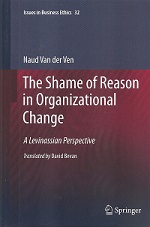
Last week The Shame of Reason appeared, the English translation by David Bevan of my book Schaamte en verandering. Right before the holidays, just in time for all those Englishmen, Americans and Australians who on their beaches en masse start reading the book.

Nonsense of course, but perhaps the ‘just-in-time’ may hold with regard to a quite different trend that occupies the media: the impending demise of the traditional booktrade. Within a few years from now, such a book as mine might not find an editor anymore, at least for a paper edition.

Everywhere I hear sad news from the side of publishers and bookshops. In Holland sales of general books shrank in the last five months by 3.8 percent and 4.7 percent in 2010. Publishers delete jobs and titles and join with one another in order to survive. Bookstores are struggling and cut staff. The book-selling markets which are currently best performing are those at the petrol station and supermarket. As causes for this development are mentioned the digitization, the economic crisis and the trend that people read less and less.

Do I myself get sad because of this trend?

Well, if the trend would stand for the demise of interesting ideas that are being well expressed, I certainly would, because I can not easily do without. And indeed, the traditional publishers and bookstores are precisely the places where one can find that. There one may even physically enjoy the nice combination of style and thinking, with or without a cup of coffee. But the question is whether those physical places are really essential and whether good writing in electronic form cannot as well meet my needs.

My gloom is even further relativized because I, frankly, never was a fan of strict literary bookshops, of the psychological novel "as a pillar of our literacy" (Maartje Somers) and of the cliques that go with them. As for me, I am rather sympathetic to those who, as Theodore de Boer recently described with respect to the Dutch poets of the fifties, radically break away from an age-old tradition of adoration of letters. Which break in the vision of De Boer is also a departure from Platonic metaphysics and classical aesthetics.

What remains is that I am pleased with the print publication of my book. Actually I have the best of both worlds, because the full electronic version is already available at the same time.

donderdag 19 mei 2011

Aristotle and the bonuses


The Dutch legal philosopher Thierry Baudet recently wrote a nice article on Ronald Dworkin, Martha Nussbaum and the sustainability of our morality. However interesting the content of the article, on this place I am primarily interested in the end of Baudet’s article. After his discussion of the subtle polemics of Dworkin with his opponents and the activism of Nussbaum, Baudet concludes with the observation that both thinkers don’t show any shortcoming when it comes to high ideals, but fail to translate these into concrete practice.

Is that never ever going to change? I wonder in bewilderment at such a conclusion every time again. Do thinkers time and again accept that they are not relevant to everyday practice and keep critics being satisfied with just noticing that lack of relevance?

Indeed, these observations on the tiresome relationship of thinking to daily life are anything but new. Thus I recently came across a statement of Goethe in which he denounces the speculative, unsensuous and disputatious nature of the work of his philosophical contemporaries. He opposes to them the fellow German countrymen “who, being businessmen, standing in the middle of life, just pay attention to practical matters: they write the best”. And the English of course, “being born as orators and as practical, reality-oriented people”. And Marx formulated his opposition to the prevailing philosophy by saying that it comes to changing the world instead of interpreting it theoretically.

But from that perspective, I find it equally appalling that Baudet promotes Aristotle as a possible remedy for too much high-mindedness and philosophical isolation. Aristotle! The one who said that knowledge of eternal things is much loftier than practical knowledge. And for whom there was nothing more preferable than to dwell in contemplation.

True, among the ancient Greeks Aristotle was the one with his feet most firmly on the ground. Probably it is even for that reason that Baudet recommends him in his article, he can serve as an example against the theorizing of Dworkin and Nussbaum. Indeed, Aristotle has, more than they have, an eye for the paradoxical character of man as a being that is constantly torn between conflicting desires and needs. Moreover, Aristotle gave more close attention to the manifestations of biological and social life than any other ancient thinker.

But when it comes to the point, as far as his fundamental orientation is concerned, Aristotle is entirely in the Greek tradition. He does not really get out of the circle of his ancient Greek colleagues who maintain a hierarchical world view with contemplation at the top and labor at the base. And where the main concern is to stay away as far as possible from labor and as close as possible to the top.

It seems to me that this focus is for a large part responsible for the continuing irrelevance of our Western thinking. As long as Plato and Aristotle remain the ultimate benchmark of our thinking this is not going to change easily. Then the gap keeps reproducing itself.

The intriguing thing is that this reproduction has a parallel in the world of management and organization. The fascination for reflection at a distance to working life is reflected in the practice of our organizations. Up to the striving to make the distance between the thinker / manager and the work as large as possible. The degree of frustration that this causes may be derived from reports, for instance from the world of care and nursing homes. “The distance between the top and the workfloor becomes astronomical. In fact, the two don’t meet anymore”. And the rewards grow along with the distance. Here the Greek ideal of a sublime distance to labor has been realized alsmost perfectly, I would say.

Almost ... and maybe not forever everywhere. Because for instance the Dutch Council for Social Development (RMO) recently gave a revolutionary opinion. It was about excellent social workers in child welfare, which now too often make the transition to management because it pays better and gives more prestige. The RMO wants to keep them in the operational work by better rewarding them, precisely if they refrain from a management position.

This actually is a paradigm shift of the first order, a break with the ancient Greeks.